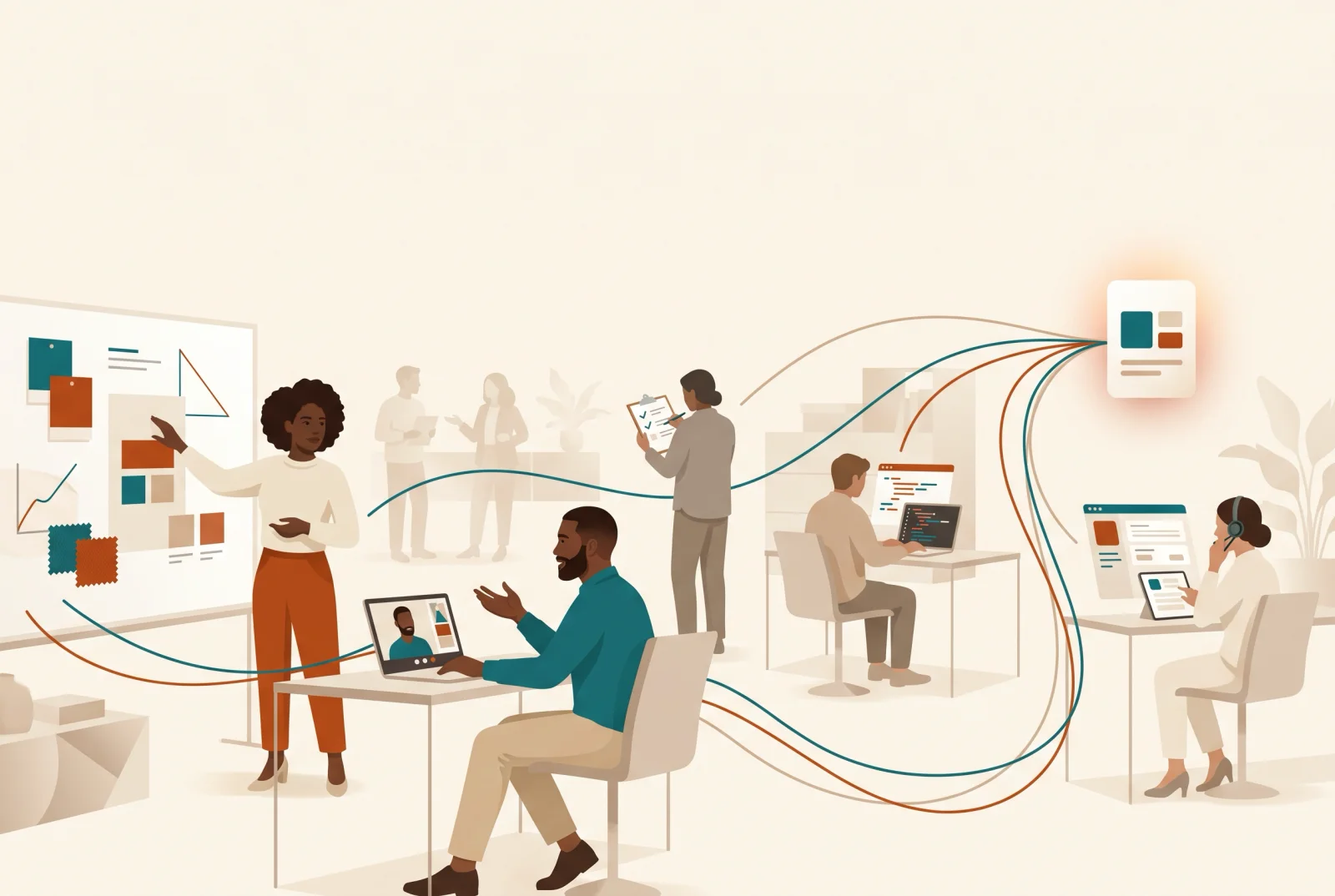
The Framework is a canonical enterprise ontology: a shared language for how people, organizations, and AI reason about the same enterprise. Organizations improve when they share that language, and become exceptional when it's intentional.
Volume
I
Philosophy
01The Experience Gap
02Experience Design Has Always Been Pervasive
03The Interface Is an Artifact
04The Outcome Is the Measure
05Business Before Interface
06Organizations Create Experiences
Chapter
01
The Experience Gap
AI didn't invent a new design discipline — it exposed how narrowly the old one was practiced. Experience is the deliberate shaping of how a whole system meets a person, from the first decision to the last consequence they carry away.
CORE PRINCIPLE
DEFINITION
Test Your Knowledge
Sign in to test your knowledge
Create a free account to unlock the full architecture.
Experience design was never confined to interfaces. Every part of an organization — marketing, operations, policy, leadership, technology — already shapes it, whether or not anyone names the work. AI only made that impossible to ignore.
CORE PRINCIPLE
DEFINITION
Test Your Knowledge
Sign in to test your knowledge
Create a free account to unlock the full architecture.
The interface is the visible output of a system, not the system itself. Define experience by the interface and your thinking goes obsolete with every technology change; define it by the system, and it lasts.
CORE PRINCIPLE
DEFINITION
Test Your Knowledge
Sign in to test your knowledge
Create a free account to unlock the full architecture.
Design is judged by the change it produces, not the artifacts it ships. As AI makes production cheap, the outcome is what separates the organizations that improve from the ones that only look busy.
CORE PRINCIPLE
DEFINITION
Test Your Knowledge
Sign in to test your knowledge
Create a free account to unlock the full architecture.
Every interface exists to serve a business objective: growth, retention, trust, revenue, compliance. Understand that objective before you design the mechanism, or you'll build decoration in service of a purpose no one named.
CORE PRINCIPLE
DEFINITION
Test Your Knowledge
Sign in to test your knowledge
Create a free account to unlock the full architecture.
Customers don't experience departments. They experience the whole organization at once — marketing's promise, engineering's product, support's resolution — arriving as one seamless thing. So experience has to be designed across boundaries, not inside one team's territory.
CORE PRINCIPLE
DEFINITION
End of Volume I — Philosophy
The rest of the Framework is free.
28 chapters across 4 more volumes. An account opens all of them — no card.
You were headed for Chapter 07 — The Capability Framework.
Every enterprise already has an ontology, whether it was designed intentionally or not. The word ontology is often tied to philosophy or computer science, but its meaning is straightforward. An ontology defines what exists within a system and what those things mean. It defines how they relate to one another and where their responsibilities begin and end. Every organization already possesses such a model — words for customers, products, workflows, decisions, authority, governance, capabilities, teams, information, value, and systems.
The challenge isn't that these concepts are missing. It's that they rarely mean the same thing to everyone. One department speaks of ownership while another speaks of responsibility. One team says workflow when it means process; another says governance when it means approval. Strategy, operations, engineering, finance, design, and technology each develop their own language for the same enterprise.
As an organization grows, these differences harden into operational friction. People make different assumptions, teams optimize different objectives, and the technology they build reflects inconsistent models. Artificial intelligence, trained on all of it, learns conflicting concepts. Decisions slow, governance turns ambiguous, and work becomes harder than it needs to be.
The problem isn't intelligence. It's the absence of a shared understanding — and that's the problem this framework was created to solve.
The Big Freight Life Framework isn't simply a collection of principles, methods, or architectures. It's a canonical enterprise ontology: a common language for how organizations create, coordinate, deliver, and sustain value. Within it, every concept has a specific definition, every capability a purpose, every architecture its ownership boundaries. Every relationship is intentional, and nothing exists in isolation. The framework should therefore be read as a connected system, not a set of independent books. Each volume develops a different layer of the same ontology.
Volume I establishes the philosophical foundation — the beliefs, principles, and assumptions that shape intentional enterprises. Volume II establishes the operational foundation, explaining how value moves through an organization and how work should be structured to create, coordinate, deliver, and sustain it. Volume III establishes the architectural foundation, defining the enterprise architectures modern organizations require and the ownership boundaries and relationships that keep those systems coherent. Volume IV establishes the organizational foundation — the capabilities, structures, skills, and operating models required to continuously design and improve the enterprise itself. Volume V establishes the human foundation — the craft, judgment, and taste that distinguish mature practitioners, and the practice that sustains Enterprise Design over a career.
Each volume answers a different question; together they answer a larger one.
How should an intelligent enterprise understand itself?
That question matters more as artificial intelligence moves from isolated tool to active participant in operations. AI doesn't reason from intuition; it reasons from representations. The quality of its reasoning depends on the quality of the concepts available to it — on the consistency of their relationships and the clarity of their boundaries.
The same has always been true of organizations. People reason through shared concepts, coordinate work through shared language, and govern through shared understanding. The challenge is no longer helping people communicate with computers. It's enabling people, organizations, and AI to reason from the same enterprise model.
That's the purpose of this framework. It isn't merely a reference for leaders, architects, designers, engineers, or operators — it's a specification for how an enterprise understands itself. The pages that follow define that understanding, not as isolated ideas but as one connected system.
Organizations improve when they share a common language. They become exceptional when that language is intentional.
The Interface Was Never the Destination
For most of the last two decades, "experience design" meant the screen. The discipline organized itself around interfaces: layouts, flows, components, the visible surface a customer touches. That surface is real work, and it matters. But somewhere along the way, the artifact quietly became the whole assignment. The screen stopped being where the work showed up and started being treated as the work itself.
The interface became the destination.
It never was.
An experience is produced long before anyone reaches a screen. It comes from pricing decisions, operational handoffs, and data that's either trustworthy or not. It comes from a policy written three years ago and the judgment of a person two departments away. The interface is simply the place where all of that becomes visible. When the screen feels effortless, it's usually because the system behind it was designed well. When it feels broken, the screen is rarely the thing that broke.
For a long time this was easy to miss. That's because a talented team can make a screen look composed even when the system underneath it isn't. Then organizations began deploying AI across products, operations, service, internal tools, and decisions, and the gap stopped hiding. A model will faithfully act on whatever system surrounds it, including its confusion. Put a capable model on top of fragmented decisions and undefined ownership, and it doesn't resolve the mess. It executes it, faster.
The model is rarely the limiting factor.
The organization usually is.
If you've ever mapped a journey that ran across marketing, sales, operations, and support, you've watched it break at the seams between them. You already know this in your body. You've been designing systems the whole time. The interface was only ever the part that showed.
Core Principle
Artificial intelligence didn't redefine experience design. It revealed what experience design has always been: the deliberate shaping of how an entire system meets a person. That shaping runs from the first decision that affects them to the last consequence they carry away.
What Actually Creates Experience
Consider a single ordinary moment. A customer opens an app to check why a shipment is late. The screen shows a status and a date. That one line of text is the visible tip of a long chain. The chain runs through how the shipment was priced and promised, and how the warehouse sequenced the work. It runs through how a delay was detected and who was accountable for flagging it, and what the data pipeline knew and when. It runs through which policy governs what the customer is allowed to see, and whether anyone designed the words that now sit on the glass. Change any link in that chain and the "experience" changes — even though the screen never moved.
Figure 1.1
The customer sees a single, calm status. The operation that produced it works out of sight behind them.
Experience is created in the interaction of everything that touches that moment. That includes business strategy and value creation, marketing and sales, operations and customer success, and policies and workflows. It includes decisions and governance, technology and AI systems, and the people running all of it. These aren't separate departments that occasionally affect the customer. They're different views of one experience. The customer never sees the org chart. They only feel the result of it.
This is the shift the framework asks you to make: to stop treating experience as a layer applied at the end. Instead, start treating it as a property of the whole system, designed from the beginning.
The Interface Still Matters
None of this diminishes the interface. A confusing screen can undo an excellent system, and a clear one can make a genuinely complex operation feel simple. The interface is where trust is won or lost in the final second, and that second is worth designing for. The point isn't that the surface is unimportant. It's that the surface isn't self-sufficient. An interface can express the quality of the system beneath it; it can't manufacture quality that isn't there. Design the screen and the system, and the screen has something true to show. Design only the screen, and you're decorating a decision you didn't make.
Why the Gap Persists
The gap is easy to fall into because each part of it looks reasonable on its own. It's also because the surface is the part everyone can see. Interfaces are visible, concrete, and easy to point at in a review. The decisions, workflows, and handoffs that determine whether an interface succeeds are diffuse and owned by no single team. Attention flows to what's legible. So a team improves the screens while the decisions behind them stay fragmented. Another modernizes the applications while the underlying workflows stay slow. Leadership invests in AI while governance stays undefined, and a product gets redesigned while the journey keeps breaking long before anyone reaches the new design. Every one of those choices is defensible in isolation. Together they optimize the surface and leave the system that determines the outcome untouched.
So the technology improves, and the numbers that were supposed to follow it don't.
Not because the technology failed. Because the system was never designed to carry it.
Definition
The Experience Gap is the distance between where organizations believe experience is created and where experience is actually created.
You Have Been Designing Systems All Along
For experience designers, this isn't a demand to become someone new. It's permission to name what you were already doing. Every time you mapped a journey that crossed departments, you were modeling a system. Every time you asked why a step existed, you were auditing a workflow. Every time you fought for a clearer error message, you were surfacing a decision that had been made badly somewhere upstream. The instinct that made you good at the screen was following the thread from what a person feels back to what produced it. That's exactly the instinct systems need now.
AI has only raised the stakes of that same instinct. The work is to follow the experience all the way back into the decisions, the data, the governance, the handoffs. The work is also to design there too, with the care you once reserved for the interface. The discipline didn't change. Its territory did.
Why It Matters Now
For most of software history, a better tool could be a durable advantage. That's ending. Soon nearly everyone will have access to comparable AI capability, drawn from the same handful of frontier models. When the intelligence is a commodity, it stops being the differentiator.
What will separate organizations is what surrounds the intelligence. That means how well AI is integrated into real decisions, and how cleanly work moves through the operation. It also means how governance holds under pressure and how coherently the whole thing meets a customer. Those are experience questions and business questions at once, and this framework argues they're the same question.
Picture two companies that license the identical model. The first drops it onto an unexamined process: the AI now answers customers faster. But it answers from the same fragmented data, inside the same undefined ownership, and it makes the old confusion move at machine speed. The second designs the system around the model first. It clarifies the decisions the AI will touch, defines who's accountable when it acts, and gives it information it can trust. And the same model produces outcomes the first company can't match. Same intelligence. Different system. The gap between them isn't technical. It's architectural, and it compounds.
An organization that understands experience as a business capability builds an advantage competitors can't copy by buying the same model. Business capability here isn't a coat of paint; it's the design of how its system produces outcomes. They'd have to rebuild the system underneath, and most won't.
Close the Gap
The interface is where your system becomes visible. It can reveal good design and it can briefly disguise bad design. But it can't repair what the system got wrong before the customer ever arrived. You can keep refining the place where the failures show — or you can design the system that decides whether there are failures at all.
Design the whole system. That's the work this book is about.
Questions for Leaders
Where does your organization believe experience is created — and where is it actually created?
What decisions, workflows, and handoffs shape a customer's outcome before they ever reach an interface?
Are your AI investments improving business capability, or only the technology?
The Experience Began Long Before the Screen
By the time a customer reaches a screen, their experience is mostly already decided. An ad set an expectation. A salesperson made a promise. A pricing rule decided what the promise could actually be. An operations team decided how fast the work would move. A policy written to protect the company decided what the customer would be allowed to know when the work ran late. The screen is where all of that surfaces at once. It is not where any of it was made.
This is the uncomfortable implication of the previous chapter. The Experience Gap is the distance between where organizations believe experience is created and where experience is actually created. Naming the gap is one thing. Living inside it is another. Once you look, you find that experience isn't being created in one place that a design team can own. It's being created everywhere, continuously, by people who'd never call what they do "experience design." The person who wrote the refund policy designed an experience. The engineer who decided a data field could be null designed an experience. The manager who set a queue's priority designed an experience. None of them meant to. All of them did.
So the discipline was never as narrow as its job titles suggested. Experience design has always been pervasive. The only thing AI changed is that pretending otherwise stopped being survivable.
Core Principle
Experience design has always existed anywhere a person meets an organization. It does not begin at the interface — it begins at the first decision that will eventually reach the person, and it continues through every decision after. The interface is simply the moment the accumulated design becomes visible.
Every Function Is Already Designing the Experience
Consider one ordinary purchase: a business orders a piece of equipment online and expects it in five days. Trace where that experience is actually shaped, and the interface barely appears.
Marketing designed the expectation: the "ships in five days" claim that the customer is now measuring reality against. Sales designed the trust: the terms a rep confirmed on a call. The customer will treat those terms as a commitment even if the fine print says otherwise. Operations designed the delivery: how the warehouse sequences work, whether the item was truly in stock, how a delay gets detected and by whom. Policy designed the consistency: what happens when the shipment slips, whether the customer is offered a credit or a script. Leadership designed the culture: whether the support agent who picks up the phone is empowered to fix the problem or trained to defend the process. And technology designed the execution: whether the systems holding all of this even agree on what "shipped" means.
Figure 2.1
Every function upstream shapes one experience; the interface is only where it becomes visible.
None of these are separate departments that occasionally brush against the customer. They're one experience, seen from different seats. The customer never sees the org chart — they feel the sum of it. When the equipment arrives on day four with a clear notification and an easy way to confirm receipt, no single team produced that. The whole system did. When it arrives on day nine with a tracking page that still says "on time," no single team broke it either. The seams did.
That's the first move this framework asks of you. Stop reading the organization as a set of functions that each own a slice of the customer. Start reading it as a single system that produces one experience — designed well or designed by accident, but always designed.
Designed by Everyone, Owned by No One
Here's the trap that keeps the gap open. Because experience is produced everywhere, it tends to be owned nowhere. Each function optimizes the thing it's measured on. Marketing optimizes the promise, because the promise drives the click. Operations optimizes throughput, because throughput drives cost. Support optimizes handle time, because handle time drives staffing. Every one of those choices is defensible on its own. Stacked together, they produce a customer who was promised five days by a team rewarded for bold promises. That customer was served by an operation rewarded for moving fast rather than moving accurately. The same customer was consoled by an agent rewarded for ending the call quickly. No one designed that experience. Everyone did.
The cost of this does not disappear. It accumulates. Each unowned seam is a small unpaid debt against the experience. Some are the promise no operation can keep. Others are the handoff where accountability evaporates, or the policy that protects the company at the customer's expense. Call it Experience Debt: the compounding gap between the experience an organization implies it'll deliver and the one its uncoordinated system actually produces. Experience Debt is easy to accrue because every individual decision that creates it looked reasonable in its own meeting. It's hard to pay down because no one holds the whole ledger. It surfaces, eventually, at the interface, the one place the customer can see. There, a support team is then asked to design a better screen for an apology that a dozen upstream decisions made inevitable.
The Interface Inherits Everything Upstream
This is why polishing the surface so rarely moves the outcome. The interface does not create the experience; it inherits it. A checkout flow inherits the pricing logic behind it. A status page inherits the honesty of the operation reporting into it. A support chat inherits every policy the agent is allowed to act on. When the system upstream is coherent, the interface has something true to show, and good screen design lets it show cleanly. When the system upstream is in debt, the interface becomes the place that debt is finally visible. No amount of layout, copy, or motion design can pay it off from there.
That doesn't make the interface unimportant. It's where trust is won or lost in the final second, and a clumsy surface can still waste a system that deserved better. But the interface can only express the quality of the system beneath it. It can't manufacture quality that was never designed in. Design the screen and the system it reports on, and the screen has something worth showing. Design only the screen, and you're decorating a decision you were never in the room for.
Definition
Pervasive experience design is the deliberate shaping of every decision that produces a customer's experience, across the whole organization — not only the interface through which that experience finally becomes visible.
You Have Been Working This Way All Along
If you design experiences for a living, none of this is new to you — it's only unnamed. Every time you mapped a journey that ran across marketing, sales, operations, and support, you were reading the organization as one system. Every time you traced a broken moment, you followed it back past the screen to the policy or the handoff that actually caused it. You were doing the pervasive work this chapter describes. Every time you argued that a fix belonged three steps upstream from the interface, you were insisting that experience is designed everywhere it's created. You didn't need permission to think that way. You needed the organization to recognize that it was thinking too narrowly.
The instinct that made you good at the surface is exactly the instinct a pervasive system needs. That instinct means following the thread from what a person feels back to what produced it. What changes now is not the instinct. It is the territory. You follow the thread further: into the pricing decision, the data model, the governance rule, the incentive that quietly shaped a team's behavior. And you design there, with the same care you once reserved for the last screen.
Why AI Makes This Unavoidable
For years an organization could get away with treating experience as an interface problem, because the damage from ignoring the rest was diffuse and slow. That grace period is ending. AI does not sit politely at the surface. It's being embedded into exactly the pervasive functions this chapter has been describing: pricing, operations, service, decisions, governance. It acts on whatever system surrounds it, including that system's confusion. Put a capable model on top of an unowned experience, and it does not repair the seams. It runs the incoherence faster, at every function at once, and prints the result on the interface with total confidence.
The model is not the experience. It's a participant in a system that produces one. If that system was never designed to be coherent, the model makes the incoherence louder, not smaller. Two organizations can deploy the identical model. The first drops it onto functions that were never coordinated. It now generates the same broken promises, the same conflicting policies, and the same false statuses at machine speed. The second designs the system first. It aligns what marketing promises with what operations can deliver, and defines who's accountable when the model acts. It also gives the model information the whole organization agrees on. The same model produces an experience the first company can't match. Identical model, opposite result. The variable was never the intelligence — it was whether experience was designed pervasively or left to accumulate as debt.
Design the Whole System
Experience was never confined to the screen, and it won't stay there now that intelligence lives in every function of the business. Your organization is already designing experiences everywhere its decisions touch a person — the only question is whether it's doing so on purpose. You can keep refining the surface where the failures finally show, and keep paying down Experience Debt one apology at a time. Or you can design experience where it's actually created. It spans the whole system, from the first decision that reaches a person to the last consequence they carry away.
Design it everywhere. That's where it was always being made.
Questions for Leaders
Where does your organization believe customer experience begins, and where does the first decision that shapes it actually get made?
Which functions are shaping the experience today while being measured on something else entirely?
Where is Experience Debt accumulating in the seams between teams, and who holds the ledger for it?
The Redesign That Changed Nothing
Almost every experienced designer has lived through the same disappointment. A product is struggling, so it gets a redesign. The team does real work: cleaner layouts, a sharper visual system, a flow that finally makes sense on the screen. It ships. It looks better than anything the company has put out in years. And three months later the numbers have barely moved. Customers still abandon at the same step, still call support with the same confusion, still feel the same friction they felt before. The surface changed. The experience did not.
That gap is the subject of this chapter. It points at the one claim the whole framework is built on. Experience design spans the entire system, from the first decision that affects a customer to the last consequence they carry away. The interface is only where that system becomes visible. When a redesign changes the surface but not the experience, it's because the experience was never living in the surface. It was living in the pricing decision, the operational handoff, the policy, the data, the judgment call two departments away. The redesign touched none of it.
The interface is an artifact. It's the visible residue of a thousand decisions the customer never sees, and it can only ever be as good as the decisions behind it.
Core Principle
The interface is an artifact — the visible output of a system, not the system itself. It expresses the quality of everything upstream of it, and it cannot manufacture quality that upstream never produced.
What an Artifact Actually Is
An artifact is the observable output of a system. The screen is one, but so is every other place a system meets a person. That includes the dashboard, the mobile app, the website, the confirmation email, and the push notification. It also includes the conversational agent and the interface an AI generates on the fly for a single request. Each of these is a surface where decisions that were already made become visible. They communicate design. They do not perform it.
Take an ordinary example. A customer receives an email that says their claim was denied. The email is an artifact: a few sentences and a button. But everything that gives it meaning was decided long before it was written. That includes the policy that defined coverage, the workflow that gathered evidence, and the judgment that weighed the claim. It also includes the governance that set who could approve it, and the data the decision drew on. Rewrite that email to be warmer and clearer, and you've improved the artifact. You haven't changed whether the denial was right, whether it was explained honestly, or whether the customer has any real recourse. The artifact is where the outcome is delivered. It is not where the outcome is produced.
This is the distinction the chapter turns on. An interface communicates the decisions that have already been made. It does not replace them, and it cannot repair them.
Mistaking the Output for the Work
The trouble begins when organizations start measuring design by its artifacts, because artifacts are the part of design that's easy to see. Screens become the measure of progress. Wireframes become the definition of the work. A polished prototype becomes the evidence that value was created. It's a natural mistake. You can hold a mockup up in a review and everyone nods. Meanwhile, the decisions and workflows that actually determine the outcome are diffuse, owned by no one in the room, and impossible to point at.
Call it Artifact Theater: the ceremony of refining the visible surface as if that were the same as improving the experience. It feels like progress because something tangible keeps getting better. Teams pour effort into interfaces while the business processes, the decision-making, the governance, and the operations underneath stay exactly as they were. The artifact improves. The experience does not. And each polished screen laid over an unexamined system widens the gap. That gap sits between how good the surface looks and how well it actually serves the person on the other side of it. That gap stays hidden until the moment a customer needs the system to work, and the beautiful interface has nothing true to show them.
The Interface Still Matters
None of this means the interface is unimportant. It's where trust is won or lost in the final second, and that second deserves everything a craftsman can bring to it. A great surface carries a great system the last inch to the customer; a careless one throws that final handoff away. The interface is necessary. It is simply not sufficient.
The precise claim is this: the artifact is the expression of quality, not the source of it. An interface can faithfully reveal a system that was designed well, and it can briefly disguise one that wasn't. But disguise has a short shelf life. Design the screen and the system together, and the screen has something honest to express. Design only the screen, and you're dressing up a verdict that was reached without you. The point was never to care less about the surface. It's to stop asking the surface to do work it was never capable of doing alone.
When the Interface Dissolves
There's a second reason this distinction is about to matter far more than it used to. For most of software's history, the interface at least held still. You could point at the screen, design it, and expect it to be there tomorrow. AI is ending that stability. Interfaces are becoming dynamic: generated in real time, assembled per request, tuned to a single user in a single moment. Some experiences are moving to voice, where there's no screen at all. Some run through background agents, automations, and APIs, where the "interface" is a sequence of actions no human ever looks at. Some artifacts will exist for one interaction and never be seen again.
If you've defined experience design as the craft of the interface, you've tied your discipline to the most volatile layer in the entire system. You'll spend the rest of your career chasing it. Every shift in technology will feel like the ground moving under you. But if you've defined experience as the design of the system that produces the artifact, then it doesn't matter. That system is the decisions, the workflows, the governance, the information, and the way AI is allowed to act. Tomorrow's output could be a screen, a spoken answer, or an action an agent takes on someone's behalf. The surface can change shape as often as it likes. The thing you designed still holds.
This is the same lesson from the other direction: the model isn't the experience, and neither is the interface it renders. Both are outputs. The experience is the system that decides what those outputs should be.
Figure 3.1
Definition
An interface is an artifact: the observable output of a system. Dashboards, mobile applications, websites, conversational agents, emails, notifications, and generated screens all communicate the decisions that have already been made. They express the design. They do not replace it, and they cannot compensate for a system that was never designed well.
What You Were Always Designing
For an experience designer, this is not a demotion of the interface you've spent a career perfecting. It is a promotion of everything you were already doing around it. When you fought for a clearer error message, you were surfacing a decision that had been made badly upstream. When you mapped a journey that crossed four departments, you were modeling a system. When you asked why a step existed, you were auditing a workflow. You were never only drawing screens — you were tracing the experience back to whatever produced it. The screen was just the part of that work that was visible to everyone else.
The business case follows the same logic. Organizations that optimize artifacts without improving systems hit diminishing returns quickly; there's only so much a better button can do for a broken process. Organizations that improve the system get better interfaces almost for free, because a healthier system has better decisions to express. Design stops being a production function that makes things look finished and becomes a driver of what the organization is actually capable of. That's a far more valuable seat than the one that only owns the last inch of the screen.
Design the System That Shows
The interface is where your system becomes visible, and that's exactly why it's so tempting to mistake it for the whole job. It's the part everyone can see, point at, and praise. But it can only ever reveal what the system already decided: good design honestly, bad design briefly. You can keep refining the place where the failures appear, or you can go design the system that determines whether there are failures at all.
Treat the interface as evidence, not as the work. Then go design the thing it's evidence of.
Questions for Leaders
What organizational decisions are your interfaces actually expressing, and are those decisions any good?
Suppose every interface disappeared tomorrow and the experience had to travel by voice, agent, and automation instead. Would the system underneath still produce a great experience?
Are you investing more in the artifacts your customers see than in the systems that determine what those artifacts have to say?
The Demo Everyone Applauded
The prototype was beautiful. The flow was clean, the transitions were smooth, the room nodded along, and the screenshot went into the next board deck. Six weeks later the metric it was built to move hadn't moved at all. Nobody had done anything wrong in that room. They had reviewed the artifact, and the artifact was genuinely good. What they never got to see, because it wasn't in the room, was the thing the artifact was supposed to change.
This is the quiet substitution at the center of most design work: the deliverable is visible, so the deliverable becomes the scoreboard. You can hold up a screen. You can screenshot a dashboard. You can point at a shipped feature and say we did that. What you can't hold up in a review is whether a customer actually got where they were going. Nor can you hold up whether a decision got better, or whether the operation got less brittle. So attention drifts to what can be shown, and the work starts optimizing for the applause instead of the result.
That drift is the same one this framework has traced from the beginning. Experience is produced across the whole system, and the interface is only where it becomes visible. An artifact is the same kind of thing, a place where work becomes visible, and it carries the same temptation. When the visible surface becomes the point, you stop designing the system that was supposed to produce something. You start decorating the evidence that you were busy.
Core Principle
The interface is an artifact.
The outcome is the measure.
What an Outcome Actually Is
An outcome is a change in the world that you can point to and defend. Not "we shipped the redesigned checkout" — that's an artifact, a thing that now exists. The outcome is "fewer customers abandon their cart on the payment step," or "support stopped getting the same three questions about shipping cost." The artifact is the noun. The outcome is the verb — something moved.
Hold a concrete moment against that test. A logistics company rebuilds the screen where a customer checks why a shipment is late. The new screen is clearer, faster, better organized; by any craft standard it's an improvement, and it's a real artifact of real work. But the outcome question is different: did fewer customers call support confused about their delivery? Did the ones who called resolve it faster? Did trust in the promised date go up? Say the delay data feeding that beautiful screen is still stale, and the underlying handoff still drops the ball. Then the customer is looking at a well-designed explanation of a problem you never fixed. The artifact improved. The outcome did not. Those are two separate claims, and only one of them is the point.
Naming that difference isn't new to you. Every designer who has ever fought past "make the error message prettier" to "why is this error happening at all" recognizes this. That designer was already refusing to accept the artifact as the finish line. You were reaching for the outcome, a person who doesn't hit the error, even when the ticket only asked for the copy. That instinct, the refusal to mistake the deliverable for the result, is exactly what this chapter asks you to make explicit and to measure.
Figure 4.1
Outputs are what you ship. Outcomes are what changes. Only the second is the measure.
Output Theater
One failure mode is worth naming because it's so easy to fall into and so comfortable to live in. Call it Output Theater: the practice of measuring the production of work as if it were the value of work. Screens delivered. Features shipped. Prototypes completed. Design-system components expanded. Every one of those is real, countable, and reportable — and not one of them tells you whether anything got better for anyone.
Output Theater feels like progress because the numbers go up and to the right. A team can have its most productive quarter on every production metric it tracks and leave the customer exactly where they started. The velocity chart climbs while the thing the velocity was supposed to serve sits flat. This is the trap of measuring what's easy to see: production is legible and impact is diffuse. So the organization instruments the part it can count. It quietly stops asking about the part that matters.
The tell is simple. When you ask a team how the work is going and the answer is a list of what shipped, you're in Output Theater. When the answer is what changed because of what shipped, you're out of it. The cure isn't to stop shipping — artifacts are how outcomes get produced. The cure is to refuse to let the artifact count as the outcome. Shipping is the means. Something changing is the point.
Say It as an Outcome
Most goals arrive stated as artifacts. The fastest way to design for outcomes is to rewrite the goal until it names the change instead of the thing. This is a move you can make out loud, in the room, before any work starts.
Weak: Redesign the onboarding screens.
Stronger: Cut the share of new customers who abandon setup before they reach first value.
Weak: Ship the analytics dashboard.
Stronger: Get three decisions currently made on gut feel onto evidence the dashboard exposes.
Weak: Add an AI assistant to support.
Stronger: Resolve the top five repeat issues without a customer waiting for a human, and know when the assistant is wrong.
Weak: Modernize the claims interface.
Stronger: Shorten the time from a claim arriving to a defensible coverage decision, without loosening the judgment.
Notice what the stronger version does. It names a subject (a customer, a decision, an operation), a direction (fewer, faster, more evidence), and an implied way to know whether it happened. The weak version names a deliverable and stops. The stronger version is harder to write because it forces you to admit what the work is actually for. That difficulty is the whole value. A goal you can't restate as a change is usually a goal nobody has connected to a reason yet. Restate it before you build, and the artifact you produce has something true to aim at.
Why This Decides Who Wins Now
For most of software history, producing the artifact was the hard part, so measuring production was a rough proxy for measuring value. That proxy is breaking. AI is collapsing the cost of production — screens, copy, code, prototypes, whole working flows can now be generated faster than a team can review them. When anyone can produce the artifact cheaply, the artifact stops being evidence of anything. Production becomes easy. Differentiation does not.
This is the same argument the opening of this framework made about the model itself. When the intelligence is a commodity, the intelligence stops being the differentiator, and what surrounds it takes over. The measurement version of that claim is direct. If two companies can each generate the same interface in an afternoon, the one that wins isn't the one that shipped it. They both did that. The winner is the one that knew what the interface was supposed to change and can prove whether it did. An organization that measures production in the AI era is counting something that has become nearly free. An organization that measures outcomes is counting the only thing left that's scarce.
There's a sharper edge here, too. A system optimized for output will now produce more output than ever, which means it can move faster in the wrong direction than ever. Point a capable model at "ship more features," and it will. The result: features nobody asked for, solving problems nobody had, each one a clean artifact and a net loss. Speed without an outcome to steer toward is not an advantage. It is Output Theater at machine scale. The organizations that pull ahead will be the ones that spent their design discipline deciding what should change and holding themselves to it. So all that cheap production has somewhere worth going.
Definition
An outcome is a measurable change in business performance, customer experience, organizational capability, or operational effectiveness that results from intentional design. Artifacts communicate the work. Outcomes are what the work was for.
Measure What Changed
The interface is where your system becomes visible, and the artifact is where your work becomes visible. But visibility is not value. The two are easy to confuse precisely because both are the parts you can see. You can keep scoring the work by what it produces. That will feel productive and will get easier every year as the tools get better at producing. Or you can score it by what it changes. That's harder, less flattering in the short term. It's also the only measure that survives contact with a competitor who can generate the same artifacts you can.
Decide what should be different because you did the work. Name it before you build, in terms of a customer, a decision, or an operation. Then hold the work to that, not to the deliverable that was only ever the means. The artifact will always be the thing you can hold up. Refuse to let it be the thing you measure.
Measure the outcome. That's the work.
Questions for Leaders
How does your organization currently measure the value of design — by what it produced, or by what changed?
Which of your current success metrics describe production, and what outcome was each one supposed to stand in for?
For the work in flight right now, can you name the customer, decision, or operational change it's meant to move? And would you know if it didn't?
The Problem You Were Handed
A design team is handed a brief: the checkout is losing customers, redesign it. They do excellent work: a cleaner form, fewer fields, a faster path to done. It ships. Abandonment barely moves. The screen got better and the business problem stayed exactly where it was, because customers weren't leaving over the layout of the form. They were leaving over a shipping cost added at the last step. It was a pricing decision made in a spreadsheet three floors away, months before anyone opened a design tool.
This is the most common way good design fails to produce business value. Not through weak craft — through arriving after the decision that actually determined the outcome. Experience is produced across the entire system, from the first choice that shapes it to the last consequence a customer carries away. The interface is only where that system becomes visible. Design the screen without understanding the business that feeds it, and you refine the one surface that was never the problem.
The uncomfortable part is that the redesign will still look like a success. The form is measurably better. The team did what it was asked. But "what it was asked" was a mechanism — fix the checkout — handed down in place of the objective. The objective was to sell more without eroding margin. Nobody set out to skip the business. It simply wasn't in the room when the brief was written. So the work optimized the surface and left the decision that governed the outcome untouched.
Core Principle
Every interface exists to serve a business objective. Growth, retention, efficiency, trust, revenue, compliance — one of these is the reason the screen is being built at all. Understand the objective before you design the mechanism, or you will build a mechanism in service of a purpose no one named.
What "The Business" Actually Is
"Understand the business" sounds like advice and behaves like a wall. It's easy to nod at and hard to act on, because the business isn't one thing you can read in an afternoon. It's a stack of decisions, most of them made before design was invited, each one shaping what a good experience even is.
Understanding the business means understanding how it makes money and how that money is actually earned: the model and the value it creates. It means knowing who it serves and how those people behave when no one is designing for them. It means knowing how the organization competes and what it competes on, and how work moves through operations and where it snags. It means knowing what decisions and governance constrain what anyone is allowed to build. It means knowing what the technology can and can't do, and how success will be measured after launch.
Figure 5.1
The interface is the top layer, built to express the business understanding beneath it.
Of that stack, the piece most often missing is the last one: how success will be measured. It sounds like a formality and it is the whole game. A team told to "improve the checkout" will build one kind of screen. A team told to "raise completed orders per hundred visitors without cutting margin" will build another. The second team has a target it can steer toward, and the first has only a surface to polish. A metric is not paperwork attached after the fact. It's the objective made testable, and design that doesn't know its metric can't know whether it worked.
Return to the checkout. A designer who understood the business would've asked, before touching the form, where the margin lives and what the company is actually optimizing. That single question routes to the pricing model, and the pricing model is where the shipping surcharge hides. The redesign was never going to reach it. The lever that moved the outcome sat one layer down from the layer the brief pointed at. This is what business understanding buys you. Not a better screen, but the ability to tell whether the screen is where the problem is at all.
Notice that none of this is unfamiliar territory for an experience designer. Following a customer's frustration back to the pricing decision that caused it is one move. Following a broken journey back to the handoff that broke it is the same move. You already trace consequences to their source. Business understanding is that instinct pointed one direction further upstream — past the workflow, into the strategy that set the workflow in motion.
When Design Becomes Decoration
Without business understanding, design becomes decoration rather than strategy. That's not a slur on craft. A decorated screen can be genuinely beautiful, usable, and precise. The word means something exact here: decoration is design applied to a decision it didn't participate in and can't change. It makes the outcome look better without making it be better, because it never touched the mechanism that produces the outcome.
Strategy is the opposite posture. Strategic design gets close enough to the business to influence the decision, not just render it. It arrives while the problem is still being defined and asks whether it's the right problem before committing a team to solving it. The difference between the two is not talent or tooling. It is timing and access. It is whether design is in the room where the objective is set, or downstream of it, receiving requirements as finished facts.
The distinction shows up everywhere once you look for it. A banking app gets a new dashboard when the reason customers call support is a fee they can't find an explanation for. The dashboard is decoration, and the explanation the business never wrote is the strategy. A support tool gets a friendlier tone when the reason tickets pile up is a returns policy that guarantees a second contact. The tone is decoration, and the policy is the strategy. In each case the visible work is real and the underlying decision is untouched, so the numbers that justified the project never move. Decoration is not defined by how it looks. It is defined by what it is powerless to change.
This is why the argument is business before interface and not business and interface. Sequence is the whole point. Understand first, then design — because a design decision made without the business is a guess wearing the costume of a solution. The organization will pay for the guess, whether or not the screen looks good.
Definition
Business before interface means understanding why the organization exists, how it creates value, and who it serves. It means understanding how it competes and what outcomes it is trying to achieve, before making a single design decision. Design begins with purpose. The interface is how that purpose becomes visible.
The Stakes Rise With AI
Everything above was true before AI, and easy to survive without. A misdirected redesign wastes a quarter; the business absorbs it and moves on. AI removes that margin for error, because AI executes the business it's given.
Drop an AI assistant onto the same misdiagnosed checkout (one that answers questions, recovers carts, nudges the hesitant buyer). It will work the abandonment faster and more tirelessly than any team could. It will also work the wrong abandonment faster, because it inherited the same misunderstanding of why customers leave. The model doesn't discover that the real problem is a pricing decision. It optimizes against the problem it was pointed at, at machine speed, and the surcharge keeps costing exactly what it cost before. Same confusion, more throughput.
This is the sharper edge of the same principle. A model deployed on a business no one designed for produces decoration at scale: fluent, fast, and aimed at the wrong target. The organizations that win with AI are not the ones with the better model. They are the ones that understood the business well enough to point the model at the decision that actually moves the outcome. That understanding is design work. It was always design work. AI only raised the price of skipping it.
Design Begins With Purpose
The interface is where your business becomes visible to a customer. It can express a strategy that is sound, and it can briefly flatter a strategy that is not. But it cannot supply a strategy that was never there. Every hour spent perfecting a screen for the wrong objective is an hour the business pays for twice. Once to build it, and again to discover it didn't matter.
So start where the outcome is actually decided. Understand how the business creates value, who it serves, how it competes, and what it's trying to achieve. Only then design the interface that makes all of it visible. Get the business right, and the screen finally has something true to express.
Understand the business first. Then design.
Questions for Leaders
Does your design team understand how your business creates value, well enough to challenge a brief, not just execute it?
Are designers participating in the decisions that set your objectives, or reacting to requirements after those decisions are already made?
What would change if design were in the room before the problem was defined, rather than handed the problem to solve?
The Customer Never Sees the Org Chart
Walk into any company and ask who owns the customer experience. You'll usually get a confident answer: design, or product, or a team with "experience" in its name. It's a reasonable answer. It's also, on its own, the wrong shape for the problem. That's because the customer on the other side of that experience never sees the team that supposedly owns them. They never see the departments at all.
They see one continuous thing. A promise, and whether it was kept. A price, and whether it was fair. A wait, and whether anyone told them why. What reaches the customer is a single, undivided impression. That impression was assembled by dozens of hands that never met in the same room. Marketing shaped the expectation. Sales set the terms. Engineering built the thing. Operations delivered it. Support caught what fell. Leadership wrote the policy that decided how much any of them were allowed to bend.
Every one of those functions felt, from the inside, like a separate job. To the customer they are one experience. This is the same truth the first chapter drew: experience spans the whole system. It spans from the first decision that touches a person to the last consequence they carry away. The interface is only where that system becomes visible. This chapter names the system. It is the organization.
Figure 6.1
Separate decisions across an organization add up to one customer experience.
Core Principle
Organizations create experiences.
Customers do not experience departments. They experience the promise marketing made, the expectation sales set, the product engineering shipped, the service operations ran, the resolution support delivered. It all arrives at once, as one thing, with no seam between them that they can see. Technology carries these interactions. The organization is what orchestrates them. Every decision made anywhere inside it contributes to the experience that lands outside it.
One Customer, Six Departments
Abstractions about "cross-functional experience" are easy to nod at and easy to forget. We've followed a version of this purchase before. Earlier it showed how every function quietly designs. Follow it once more, and this time watch the seams between the functions rather than the functions themselves. That's because the seams are where the experience is actually decided.
A marketing campaign promises fast, worry-free delivery. That promise is a design decision — it sets what the customer will expect before they've touched anything real. A salesperson, working to a quota, confirms a delivery window that operations never agreed to. That's a second design decision, made in a different building, that quietly rewrites the first. The order reaches a warehouse whose scheduling was optimized for cost, not for the window sales just promised, so it ships a day late. Nobody in the warehouse did anything wrong by their own metric; they hit the target they were given. A tracking screen — clean, well-built, genuinely good work by the team that made it — now displays a delivery date. That date contradicts what sales said. That's because the two systems were never taught to speak. The customer, confused, contacts support. The support agent can see the shipment but not the sales promise. The agent can't authorize the goodwill credit that would fix the moment, because policy reserves that authority two levels up. So the agent does the one thing that guarantees the customer remembers this forever: apologizes, and explains that there's nothing they can do.
No single person failed. The screen was excellent. The warehouse hit its number. The agent followed the rules. And the customer walked away with a broken experience. It was assembled, decision by decision, by six departments that each optimized their own square and never owned the whole. The failure did not live in any of the parts. It lived in the seams between them, which belonged to no one.
This is what it means to say experience is created by the organization. The quality the customer felt was not the quality of the best-designed department. It was the quality of the connections between departments — and connections are exactly what a team-by-team view of ownership leaves undesigned.
Why Ownership Fragments
The fragmentation is not a sign of a badly run company. It is the default state of a well-run one, and understanding why is the whole point.
Every department is given a metric it can control and rewarded for moving it. Marketing owns awareness, sales owns acquisition, operations owns delivery, support owns resolution. Each optimizes locally, because local is what it can see and what it's measured on. What none of them is measured on is the space between their work and the next team's. That space is the handoff where the promise becomes an order, the order becomes a shipment, the shipment becomes a status a customer reads. Those seams are diffuse, shared, and owned by no single team, so attention flows past them to the parts that are legible and countable. The experience the customer receives is manufactured almost entirely in the places no one is watching.
Left unaddressed, those seams accumulate into Experience Debt, the compounding cost this book named earlier. Seen from the inside, that's every handoff that was never designed, every promise one function made that another was never told to keep. It does not show up on any one team's dashboard. It shows up in the customer's memory, and eventually in the numbers, long after the decisions that caused it have been forgotten.
Experience Design Is the Connective Tissue
If the failure lives between departments, then the discipline that fixes it can't live inside one. This is where the role of experience design becomes clear, and where it stops looking like a function and starts looking like a responsibility.
Experience design is the connective tissue. Its job is not to own marketing's messaging, sales' targets, operations' scheduling, or engineering's roadmap. A design team that tried to absorb every function would collapse under it and deserve to. Its job is to understand how those functions combine into a single experience and to make the seams between them visible. It also has to align the decisions on either side of a handoff, so the thing that reaches the customer is coherent rather than accidental. It designs the connections, not the departments.
If you've spent years as an experience designer, this isn't a new job being handed to you. It's a name for the one you were already doing. You mapped a journey that ran across marketing, sales, operations, and support, and you watched it break at the boundaries. Every time that happened, you were seeing the organization as a system. Every cross-functional workshop you ran to get four teams to agree on one moment was connective-tissue work. You were never really designing screens. You were designing the agreement between departments that the screen would eventually display. That instinct made you follow a customer's frustration back to the upstream decision that caused it. It's exactly the instinct an organization needs to close its own seams. You already have it. This chapter is only insisting it be pointed at the whole organization, out loud, with a mandate.
Why This Decides Who Wins With AI
None of this is new. Organizations have always created experiences across their functions, and the seams between departments have always been where experiences broke. What's new is the speed at which those seams now propagate — and that changes the stakes of getting this right.
Artificial intelligence increases how fast an organization operates. It does not reduce how complex an organization is. Drop a capable model onto the six-department purchase above without touching the fragmentation underneath. The model does not heal the seams — it does not even see them. It answers the customer faster, from the same disconnected data, inside the same undefined ownership. And it delivers the same contradiction at machine speed, with total confidence. The model is not the organization. It'll faithfully execute whatever coordination the organization already has, including the coordination it never designed.
So the organizations that win with AI won't be the ones with the best model. Soon nearly everyone will have access to the same frontier models, and a commodity can't be a differentiator. They'll be the ones whose people, decisions, workflows, and governance were aligned into one system before the model was added. That way, the intelligence has something coherent to amplify. Alignment across functions was always valuable. AI turned it into the thing that separates organizations that pull ahead from organizations that automate their own fragmentation.
Definition
An organization is the system that produces experience. Every function shapes what the customer feels — whether or not anyone designed it to — and experience is therefore a property of the whole organization before it is ever a property of a screen.
Close the Seams
The customer will never see your org chart, your metrics, or the handoffs where your teams pass work to one another. They'll only feel the result of all of it, arriving as one thing. You can keep optimizing each department against its own number and hope the pieces add up. They will not, because no one is designing the space where they meet. Or you can treat the connections between functions as the real object of design, and make the whole organization produce the experience on purpose.
The interface is where your organization becomes visible. Design the organization behind it.
Questions for Leaders
Who in your organization is accountable for the experience between departments — the handoffs, not the boxes?
Where does a promise made by one function get contradicted by the work of another before it reaches the customer?
Are your teams optimizing their own metrics, or one shared outcome — and would adding AI make that alignment better, or just faster?
One interface takes many forms — screen, voice, agent — all drawn from a single system beneath.